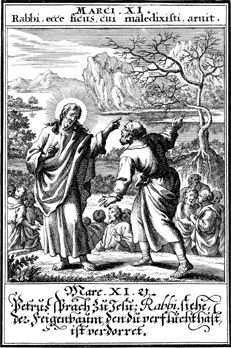
woodcut by Johann Christoph Weigel
Today's Gospel reading is Mark 11:11-26. I was ready to hear what I thought of as the prime point of the passage: that "all that you ask for in prayer, believe that you will receive it and it shall be yours "When you stand to pray, forgive anyone against whom you have a grievance, so that your heavenly Father may in turn forgive you your transgressions."
But look at the fig tree story, which is NOT a parable, a little closer. Jesus was hungry and encountered a fig tree that only had leaves, since it was not yet time for figs. He cursed the tree, declaring that it would never bear fruit again! The next day, the tree is found withered to the root, and Jesus teaches the Twelve that whatever they ask for in faith will be done. Presumably, that means that He withered the tree by asking that it happen. Or does it mean that Jesus' desire for food, being a prayer for it to the Father, should have acted upon the tree, causing to produce fruit suddenly out of season? Or?
I used to think of that phrase "nothing but leaves" as a serious warning for those who flourish within the life of the Church, but bear none of the fruit of the Holy Spirit. They sink their roots into the life of the Church, but make no fruit, set no seed. But why the detail about Jesus cursing a tree that wasn't even supposed to have fruit yet? Seems unfair, as unfair as the last-minute guest at the king's banquet who was found to be without a wedding garment. (Setting aside the apologetics arguments about the garment being the garment of baptism - I agree that this is an appropriate description, but the invitation to the unbaptized still brings the same swift trip to the outer darkness.)
Jesus is never unfair, so I'm missing the point here.


